Top 50 Oil Producers: Who Controls the World’s Crude
A data-led snapshot of the world’s top 50 crude oil producers, mapping output, refinery infrastructure, and the companies that control critical energy capacity.

Top 50 Oil Producers: Who Controls the World's Crude
Raven Intelligence Framework (RIF)
— A. Nickoll
Raven Intelligence
© 2026 Raven Intelligence — All Rights Reserved
Reference Period: November 2025
Source Base: U.S. Energy Information Administration (EIA) and related industry references
This document provides a structured snapshot of the world's top 50 crude oil-producing countries as of November 2025, based primarily on EIA data. It combines three operational layers for each country: crude oil production, major refinery infrastructure, and leading extraction and refining companies.
All figures are approximate and reflect reported production levels, refinery capacity, or operating presence at the time of reporting.
Top 50 Oil Producers
Crude oil production in thousand barrels per day (kb/d)
Key Global Patterns
1. OPEC remains structurally central
Twelve of the top 50 producers are OPEC members, accounting for roughly 36% of global crude output. When broader OPEC+ participants are included, that share rises materially, highlighting the continued weight of managed production blocs in global supply formation.
2. The United States remains the leading producer
The United States holds the top position at 13.8 million barrels per day, supported by large-scale onshore and offshore production, as well as one of the deepest refining networks in the world. Its strength lies not only in extraction volume, but in integrated upstream-to-downstream capacity.
3. Refining power is concentrated in a smaller set of states
Not all major producers possess equally strong refining systems. Some countries are major crude producers but have limited domestic refining depth, while others combine high output with strong downstream infrastructure. Production volume alone does not equal full energy system resilience.
4. Corporate concentration remains high
A relatively narrow group of state-owned giants and multinational majors continue to dominate the sector. Saudi Aramco, ExxonMobil, Chevron, Rosneft, CNPC, Petrobras, ADNOC, and NIOC remain central to both extraction and refining across multiple strategic regions.
Refinery Notes by Region
United States
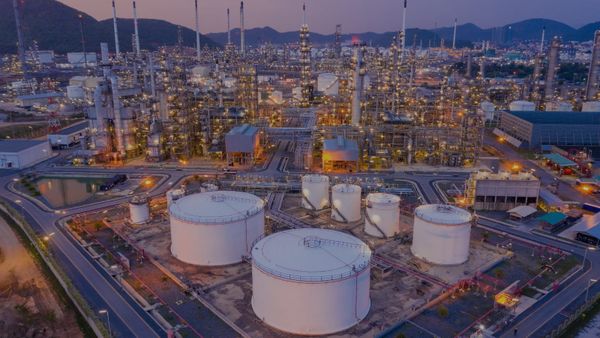
The US refining system includes some of the world's largest facilities — Galveston Bay, Port Arthur, and Baytown — giving unusual flexibility across crude intake, product output, and export capability.
Saudi Arabia
Ras Tanura is one of the most strategically important refining facilities in the global oil system, supported by Saudi Aramco's integrated upstream and downstream structure.
China and India
Asia's refining power is anchored by large industrial hubs. India's Jamnagar complex stands out as one of the largest refining centres in the world, reinforcing the region's role in domestic processing and export-oriented refined products.
Canada
Canada's system is heavily shaped by Alberta oil sands output, with refining concentration in Sarnia and Edmonton, designed to handle heavier crude streams.
Europe
Norway, the United Kingdom, and Italy maintain smaller but strategically integrated refining capacity — less dominant in absolute scale, but relevant for regional supply security and specialised market flows.
Leading Company Clusters by Region
North America
- ExxonMobil
- Chevron
- Marathon Petroleum
- ConocoPhillips
- Valero
- BP
Middle East
- Saudi Aramco
- ADNOC
- NIOC
- Kuwait Petroleum Corporation
- Qatar Petroleum
- PDO
Russia and CIS
- Rosneft
- Gazprom Neft
- Lukoil
- KazMunayGas
- SOCAR
South America
- Petrobras
- PDVSA
- Ecopetrol
- YPF
Africa
- Sonatrach
- NNPC
- Sonangol
- TotalEnergies
- Eni
Asia-Pacific
- CNPC
- Sinopec
- CNOOC
- Petronas
- Pertamina
- PetroVietnam
- Woodside Petroleum
These firms matter not just because of size, but because they anchor critical parts of national energy systems, export earnings, and geopolitical leverage.
Strategic Takeaway
This dataset is most useful when treated as more than a production ranking. It is a global energy systems map showing where crude is extracted, where it can be refined, which firms control the infrastructure, and which states retain leverage over supply chains.
Production dominance is still highly concentrated. Refining depth is unevenly distributed. State-backed firms remain central to energy power. That makes this table useful not only for commodity analysis, but also for geopolitics, infrastructure risk mapping, trade route exposure, and investment research.
Signature
— A. Nickoll
Raven Intelligence
Informational reference only — not financial, investment, legal guidance, or political prediction. © 2026 Raven Intelligence — All Rights Reserved.
If this raised questions you haven't seen answered anywhere else — that's the point.
Production volume tells you where the barrels are. It does not tell you who controls the terms under which they move, are refined, insured, and delivered. Raven tracks the control layer beneath the production map — chokepoints, corridors, access conditions, and the infrastructure that determines whether capacity becomes usable flow.
Entry, Core, and Elite tiers. Start with Entry and go as deep as your work requires.