January 2026
January 2026 Wasn’t About Collapse. It Was About Control.
Most people still look for systemic stress in the obvious places.
A route closes.
A government escalates.
A factory stalls.
A market reacts.
But that is usually the late signal.
The earlier signal is quieter. It appears when systems still function, but only inside narrower operating bands. It shows up when continuity depends less on open access and more on thresholds, permissions, reservations, activation timing, and utility readiness.
That is what January 2026 revealed.
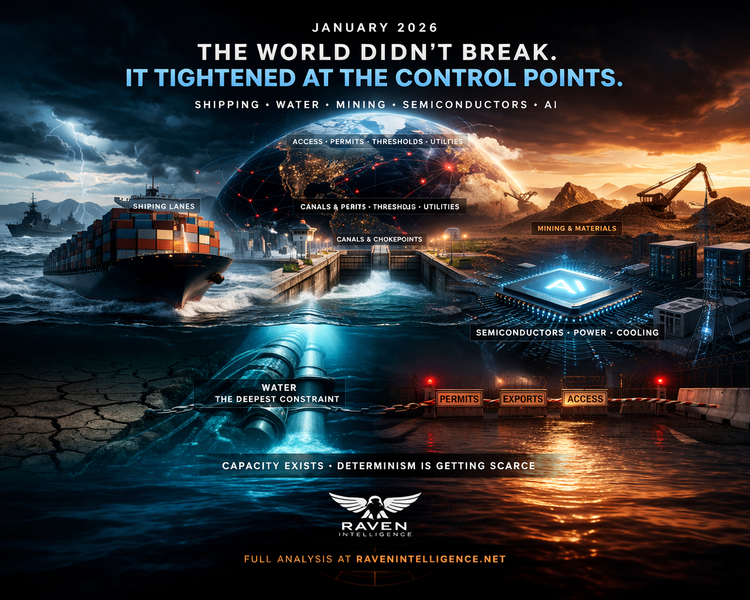
Across water, shipping, mining, semiconductors, and AI infrastructure, the same pattern kept appearing: capacity still existed, but usable capacity was becoming harder to access, harder to activate, and harder to sustain with confidence.
That is where Raven Intelligence sits.
Raven does not chase headlines after the fact. It watches the dependency stack beneath them.
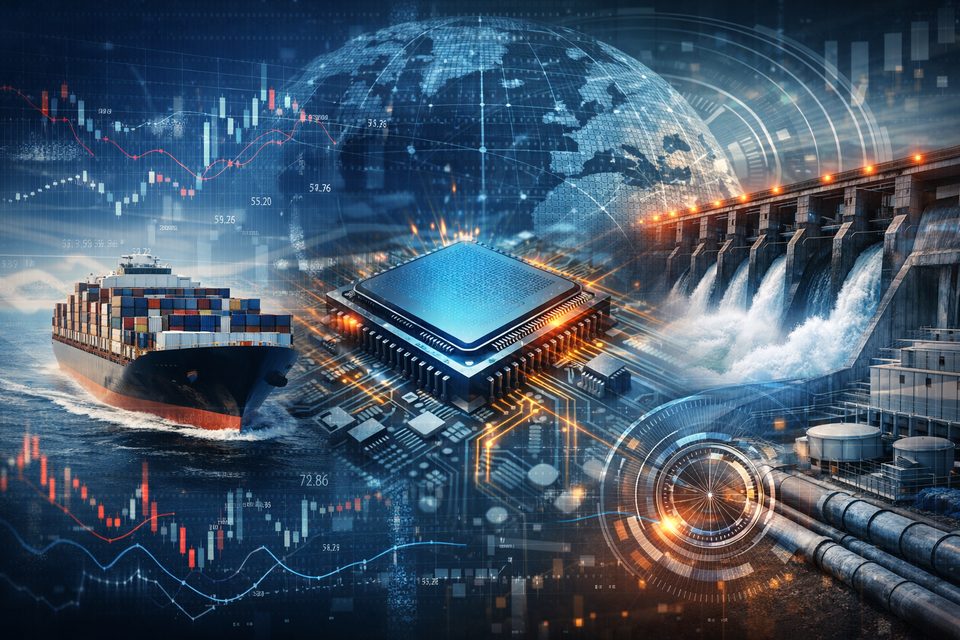
The visible AI wave may dominate attention, but AI is downstream of semiconductors. Semiconductors are downstream of materials, utilities, service activation, and timing. Those systems depend on shipping, industrial continuity, political access, and, deeper still, water.
That is the part most surface commentary misses.
The question is no longer just whether capacity exists.
The question is whether it can be accessed, activated, cooled, shipped, permitted, and sustained on acceptable terms.
In January, the answer was increasingly: yes, but only conditionally.
The Month’s Real Pattern
January did not look like a month of obvious rupture. It looked like a month where the floor plan quietly changed.
Systems remained active, but with less slack, less neutrality, and less room to improvise. Continued operation did not mean restored normality. It meant adaptation inside narrower corridors.
That pattern showed up across the stack.
In shipping, routes remained commercially usable without becoming commercially deterministic. Passage decisions were still shaped by security tolerance, insurance posture, and schedule-risk logic rather than simple shortest-path assumptions.
In Panama, throughput improved, but not into frictionless neutrality. Recovery arrived in managed form, not old-form normality.
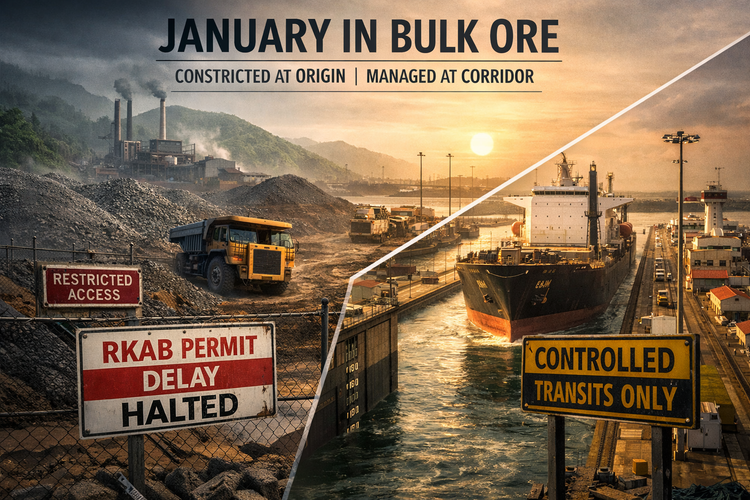
In mining, one of the strongest signals was not a collapsed corridor or a port outage. It was control at origin. Extraction freedom tightened through approvals and permit logic before vessel availability or corridor access became the main constraint.
In semiconductors, pressure moved deeper into productive activation. Delivered tools did not automatically translate into output. Presence did not equal productivity.
In AI infrastructure, hardware alone was no longer the story. Compute usability was increasingly bounded by power, cooling, commissioning, and access pathways. AI looked less like a pure software story and more like a utility-and-governance story.
Capacity still existed, but determinism was scarcer.
Movement still existed, but neutrality was weaker.
Recovery still existed, but in managed form.
Output still existed, but through tighter activation layers.
Why Raven Watches the Undercurrent
This is where Raven Intelligence becomes distinct.
Raven is not trying to be louder than the news cycle. It is trying to be earlier than it.
It watches the hidden dependency stack beneath modern civilization: water, mining, shipping, semiconductors, compute, infrastructure, regulation, and conflict. It tracks how pressure moves from one layer into the next.
Not to dramatize the chain. To make it legible before the downstream consequence becomes obvious enough for everyone else to notice.
That matters because the modern world rarely fails in a clean cinematic way first.
It tightens.
It narrows.
It shifts from open systems to managed systems.
It keeps functioning while losing freedom.
That is a harder pattern to see, but it is often the more important one.
The Deeper Question
So the issue is no longer whether the world still has capacity on paper.
The issue is whether that capacity can still move through the real-world stack with enough stability to matter.
Can ore be lawfully extracted?
Can tools be activated into productivity?
Can compute be energized and cooled?
Can corridors be used predictably enough for planning?
Can water remain a background input, or does it become the rule-set for everything downstream?
January 2026 suggested a new baseline:
The world is not primarily breaking at the edges.
It is tightening at the control points.