Gulf Compute: Why Saudi Arabia and the UAE Matter in the New Permissioned AI Order
Operator’s Brief
Gulf AI Infrastructure: Capital, Compute, and Permission
Using the Raven Intelligence Framework (RIF) as a guide, the key question is not whether the Gulf has money. It is whether Gulf states can convert capital into durable AI power through infrastructure, chip access, energy, and trusted political alignment.
The Raven Intelligence Framework (RIF) is a systems-based method for reading events through infrastructure, constraints, incentives, and second-order consequences rather than headlines, hype, or isolated announcements. In this case, that means tracking movement, direction, and consequence potential while staying focused on verifiable, system-level signals.
Executive Take
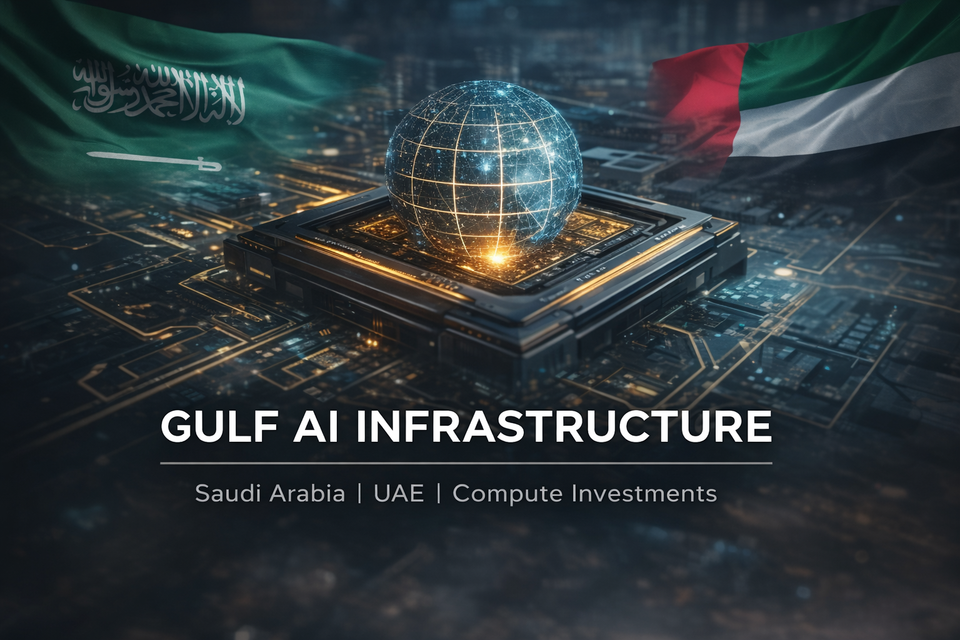
Saudi Arabia and the UAE are now two of the most important non-U.S. jurisdictions to watch in AI infrastructure. Both are trying to move from being capital-rich buyers of technology to becoming hosting zones for large-scale compute. Saudi Arabia’s Public Investment Fund launched HUMAIN in May 2025 to build across the AI stack, including data centers, cloud, models, and applications. The UAE’s Stargate UAE project in Abu Dhabi is planned as a major AI infrastructure cluster, with the first 200MW expected to come online in 2026.
The strategic point is simple: if AI is becoming a permissioned domain at the top end, then the Gulf matters because it has three things many regions do not have at once — capital, energy, and state-level coordination. What it still needs is the harder ingredient: continued trusted access to U.S. chips, cloud partnerships, and compliance acceptance.
The Who
Saudi Arabia
Saudi Arabia’s main AI vehicle is HUMAIN, launched by the Public Investment Fund in May 2025. Officially, HUMAIN is intended to operate across the full AI value chain, including next-generation data centers, cloud capabilities, and advanced AI models. Reuters reported that Nvidia would begin by sending 18,000 Blackwell chips to HUMAIN and that AMD entered a $10 billion collaboration tied to 500MW of AI compute infrastructure.
United Arab Emirates
The UAE’s central AI actor is G42, backed by Abu Dhabi and linked into major U.S. technology partnerships. The most important project is Stargate UAE, a planned 1GW cluster within a broader 5GW Abu Dhabi AI campus. Reuters and OpenAI both stated that 200MW is expected to go live in 2026, with OpenAI, Oracle, Nvidia, Cisco, and SoftBank involved.
The External Players
The Gulf story is not just Saudi Arabia and the UAE. The outside actors matter just as much:
- Nvidia and AMD, because chip supply defines ceiling height.
- OpenAI, Oracle, Microsoft, Cisco, and SoftBank, because they bring software, cloud, networking, and ecosystem legitimacy.
- Washington, because U.S. export permission and security trust still shape what the Gulf can actually build at the frontier.
The What
This is not merely a story about “AI investment.” It is a contest over where frontier compute can physically sit, who can operate it, and under what political and compliance conditions. That fits the Raven Intelligence Framework emphasis on infrastructure, policy, logistics, and second-order consequences rather than headline noise.
Saudi Arabia and the UAE are trying to become more than customers. They are trying to become:
- regional AI hosting hubs,
- compute aggregation points,
- sovereign or quasi-sovereign AI platforms,
- and strategic partners in a U.S.-aligned AI buildout.
In plain language, this is a move from buying tools to owning part of the workshop.
The Where
Saudi Arabia
The Saudi buildout is centered on HUMAIN, with Reuters reporting early data-center construction in Riyadh and Dammam, each beginning at 100MW scale. That matters because it turns abstract ambition into physical infrastructure with named sites, measurable capacity, and imported frontier semiconductors.
Abu Dhabi / UAE
The UAE effort is centered in Abu Dhabi, where Stargate UAE is planned as part of a wider 5GW UAE-U.S. AI campus. The scale matters here. A campus of that size is not a vanity server room; it is an attempt to become a globally relevant compute node.
The Wider Gulf
The broader region matters because Gulf states combine:
- sovereign balance-sheet capacity,
- access to power,
- strong state planning traditions,
- and incentives to diversify beyond hydrocarbons.
That does not automatically make them AI powers, but it makes them unusually plausible candidates.
Why We Should Keep an Eye on It
1. Capital is trying to buy entry into the permissioned AI order
The Gulf may be one of the clearest cases where sovereign wealth is being used to purchase not just infrastructure, but admission into the frontier AI ecosystem. That is a major structural signal because it shows AI power may no longer be confined to the United States, China, and a few East Asian manufacturing centers.
2. Energy plus compute is becoming a strategic bundle
Large AI campuses require power, cooling, land, and financing. The Gulf is one of the few regions that can plausibly assemble those at scale. That makes Saudi Arabia and the UAE important not just as investors, but as potential physical hosts for AI capacity.
3. U.S. trust remains the gating factor
Reuters reported that major UAE data-campus plans faced Washington scrutiny over security concerns, and that some deals were far from finalized because of those issues. That means the Gulf story is not simply, “they have money, therefore they win.” It is, “they have money, but must still satisfy the U.S. trust and compliance layer.”
4. Grey-market pressure could emerge later
Once advanced chips, compute access, and cloud relationships become strategically valuable and politically gated, pressure builds around routing, intermediaries, hosted access, and compliance laundering. The Raven Intelligence Framework would treat that as a second-order consequence, not as immediate proof — but it is a logical downstream risk if access remains restricted and demand remains high.
The Operator Read
This is the cleanest way to frame it:
The Gulf is where oil wealth is trying to become compute power.
That matters because the future AI order may be shaped less by who can merely write a check and more by who can combine:
- capital,
- power generation,
- physical campuses,
- U.S. chip access,
- trusted governance posture,
- and cloud/ecosystem integration.
Saudi Arabia and the UAE are among the very few places outside the United States that can even attempt that combination at scale.
What to Watch Next
Under the Raven Intelligence Framework (RIF), the right indicators are not speeches or glossy announcements. They are observable signals.
1. Chip approvals
Are Saudi and UAE entities continuing to receive access to top-end U.S. chips, or does access become narrower, delayed, or more conditional?
2. Megawatts actually going live
Announcements are cheap. Live capacity is signal. Watch for confirmed energization, server deployment, and customer onboarding. The real test is conversion from plan to operation.
3. Who operates the stack
If the infrastructure sits in the Gulf but is effectively wrapped, monitored, and controlled by U.S. firms, that is not the same thing as full sovereign AI autonomy. It is still important, but it is a different category of power.
4. Security and compliance architecture
Working groups, safeguards, auditability, export conditions, and “responsible deployment” language are not decoration here. They are often the real terms of admission.
5. Whether the model spreads
If Saudi and UAE buildouts trigger follow-on moves in Qatar, Bahrain, or other Gulf jurisdictions, that would indicate a regional compute competition rather than isolated prestige projects. Current evidence is strongest for Saudi Arabia and the UAE; the wider Gulf case remains more watchlist than proof.
Final Assessment
From a Raven perspective, Saudi Arabia and the UAE are not side stories. They are emerging junction points in the struggle over where advanced AI infrastructure can be built and who gets access to the top tier of compute. The signal is not that the Gulf has already broken into full AI sovereignty. The signal is that it is making a serious bid to do so through capital, energy, infrastructure, and alignment with U.S. technology partners.
The core operator question is this:
Is the Gulf becoming a true frontier compute zone, or merely a hosted extension of the U.S.-led AI system?
That is the question worth tracking.