February 2026
February 2026
The AI Revolution Moves Through Narrower Gates
February 2026 did not deliver a single dramatic break in the AI story. It revealed something more consequential: the revolution is still advancing, but through narrower gates.
That matters because AI is no longer just a software narrative. It is a physical systems narrative now. It depends on chips, packaging, power admission, water continuity, logistics, compliance, lawful extraction, corridor stability, and the ability to keep all of those systems running under pressure. Across the February material, the recurring pattern was not collapse. It was conditional scale. Systems still moved, but fewer moved on neutral terms.
The important shift is subtle. It is no longer enough that capacity exists somewhere in the system. It has to remain admissible, operable, and continuous. February showed that availability is not the same as access, infrastructure is not the same as deliverability, and nominal capacity is not the same as usable flow.
That is the real AI signal.
AI scale is increasingly shaped by the systems around the model: compliance throughput, identity controls, auditability, grid admission, curtailment conditions, HBM allocation, advanced packaging sequence, water treatment, route stability, and maintenance depth. In other words, compute is no longer simply bought. It must be cleared, powered, cooled, sequenced, and governed.
This is why February should not be read as either an acceleration story or a failure story. It is better understood as a compression story. The system kept moving, but through fewer neutral options. Choice shrank before rupture appeared. That is a very different kind of signal, and a more important one.
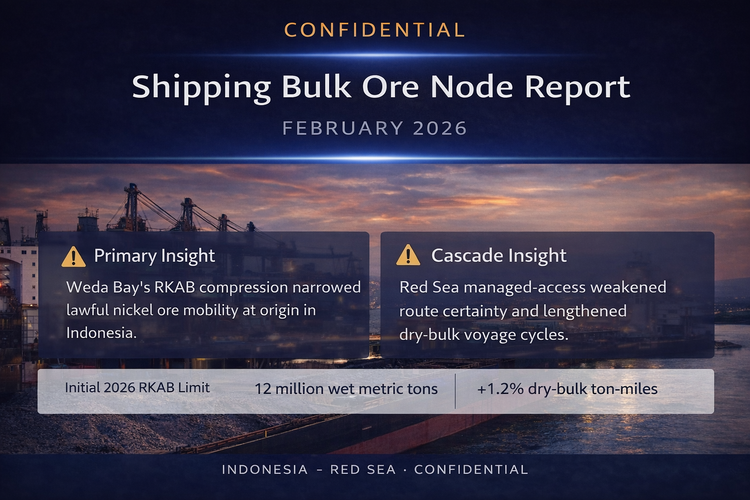
The same pattern appeared far upstream. In mining, February showed that lawful extraction itself is part of the same tightening geometry. At PT Weda Bay Nickel in Indonesia, the key issue was not geology or vessel shortage. It was sovereign control over how much ore could lawfully move at origin. That is a useful reminder that the AI era still rests on industrial systems that can be narrowed by permission, not just by scarcity.
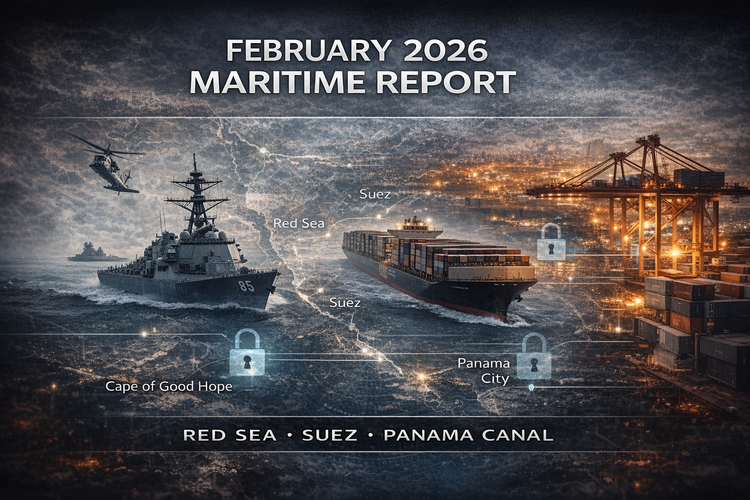
It appeared at corridor level as well. The Red Sea–Suez system remained usable, but under a managed-access regime rather than restored neutral passage. That distinction matters. A corridor can remain technically open while still degrading timing, route confidence, insurance tolerance, and delivery determinism. For industries that depend on long, synchronized supply chains, that is not a side note. It is operating reality.
So who wins in this environment?
Not just the firms with the best models. Increasingly, the winners are the actors with leverage over the surrounding stack: compliant compute access, backend semiconductor coordination, power-secured datacentre corridors, water treatment and storage, lawful resource flow, and logistics systems that can absorb rerouting and timing variance. The advantage is shifting toward those who can align infrastructure, permission, and continuity at the same time.
The relative losers are those still built for an older world: one where access was broad, utilities were neutral, shipping lanes were background conditions, and compute could be treated as a procurement problem rather than an operating system problem. February suggests that assumption set is degrading. Capacity may still exist. But access to usable capacity is becoming more conditional.
The wider economic implication is hard to ignore. The global economy is becoming less open-field and more corridor-based. More value will flow toward regions and institutions that can offer reliable power, clean compliance posture, water depth, backend coordination, legal clarity, and continuity under stress. The AI revolution may remain global in narrative, but it is becoming more regional in actual capability.
There is a social implication too. As advanced infrastructure becomes more conditional, participation is increasingly sorted by who is verifiable, governable, interruptibility-tolerant, redundancy-capable, and institutionally legible. That does not mean a doomsday future. It means a more layered one. A world where resilience, clearance, and operating depth become sources of power in their own right.
That is where February 2026 really leads.
Not to the end of the AI buildout. And not to frictionless expansion.
To a world where the future belongs less to whoever talks loudest about intelligence, and more to whoever can still feed it, power it, cool it, route it, license it, and maintain it through tightening conditions.
The question is no longer whether AI demand exists.
The question is which systems can still carry it.